Improved Efficiency and Effectiveness
Tax administration processes become faster, more accurate, and more transparent.
The Directorate General of Taxes is an Echelon I Unit under the Ministry of Finance. In general, official websites of RI Government ministries/agencies end in .go.id
Secure websites using HTTPS display a (lock) icon. Website addresses starting with https:// are a form of security, indicating that the data flow and communication between your browser and the website server is encrypted.


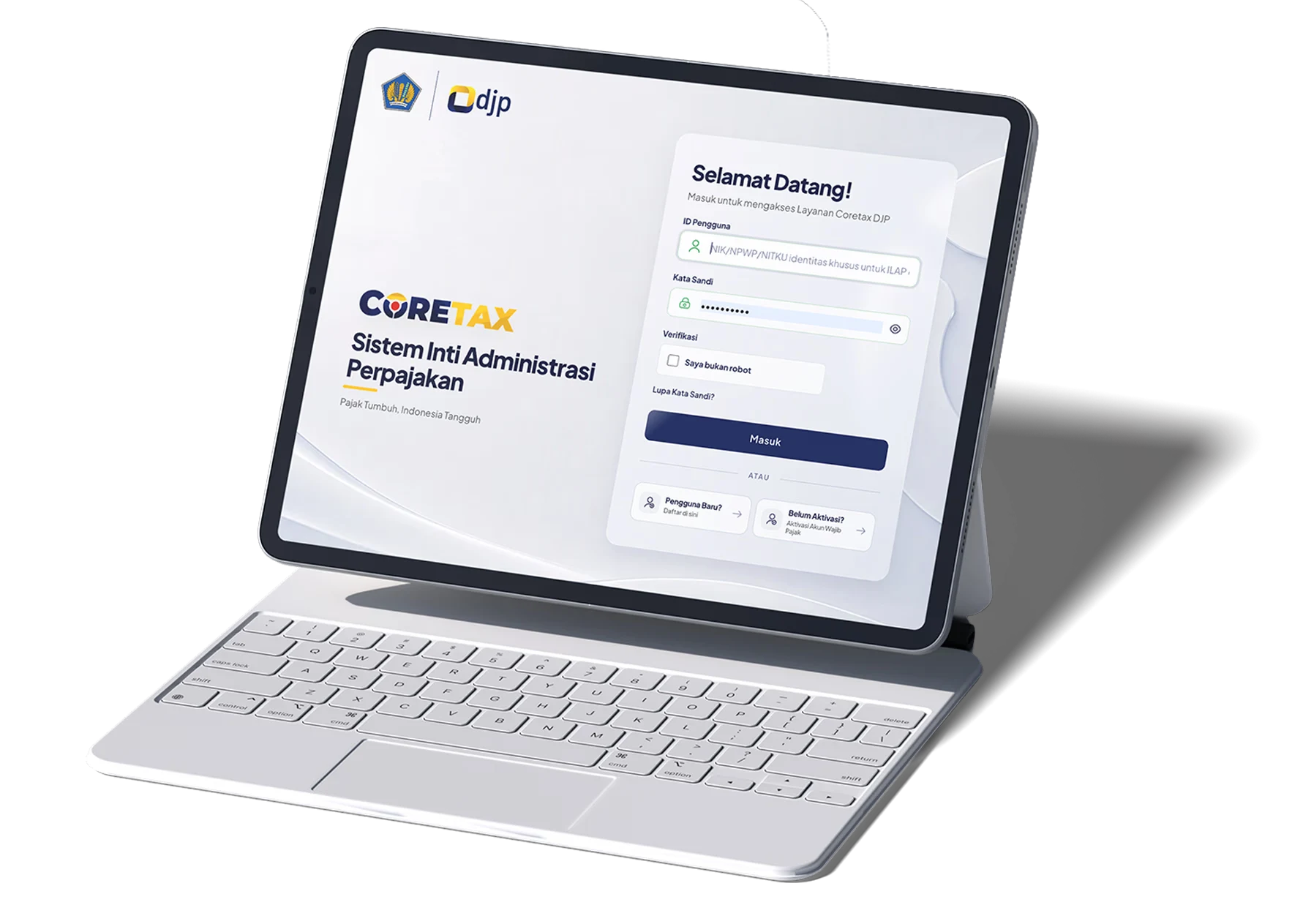
Coretax is the service administration system of the Directorate General of Taxes that provides convenience for users. The development of Coretax is part of the Core Tax Administration System Renewal Project (PSIAP) regulated in Presidential Regulation Number 40 of 2018. The Core Tax Administration System Renewal Project (PSIAP) is a tax administration business process redesign project through the development of a COTS-based (Commercial Off-the-Shelf) information system accompanied by improvements to the tax database.
The main objective of Coretax development is to modernize the existing tax administration system. Coretax integrates all core business processes of tax administration, from taxpayer registration, tax return filing, tax payment, to tax audit and collection.
To access Coretax DJP, Kawan Pajak can visit coretaxdjp.pajak.go.id.
Some of the benefits of implementing Coretax include:
Tax administration processes become faster, more accurate, and more transparent.
The ease of reporting and paying taxes is expected to encourage taxpayer compliance.
Tax services become more accessible and integrated.
Integrated tax data can be processed to produce better analysis for policy making.
The Core Tax Administration System Renewal (PSIAP) is part of the Tax Reform that focuses on redesigning business processes, updating information technology, and improving the databases used by DJP.
The Tax Administration System Renewal Program, in accordance with Presidential Regulation Number 40 of 2018, is based on several related regulations. Among them:
Minister of Finance Decree Number 36/KMK.01/2014 contains 87 main initiatives divided into 10 reform themes, of which 16 initiatives are the responsibility of the Directorate General of Taxes. These initiatives cover business processes, information technology, human resources, and organization.
In 2016, Minister of Finance Decree Number 974/KMK.01/2016 reduced the number of initiatives to 20, with two strategic initiatives under the responsibility of the Directorate General of Taxes, namely Securing Tax Revenue from Government Expenditure (RBTK 5) and Information System Modernization for Optimizing Tax Revenue (RBTK 6/Core Tax).
In 2017, Minister of Finance Decree Number 360/KMK.03/2017 established five main themes of the Tax Reform Program: organization, human resources, information technology and databases, business processes, and laws and regulations, elaborated into 21 strategic initiatives, including Core Tax modernization.
The implementation of this Core Tax modernization was reinforced by Presidential Regulation Number 40 of 2018 on the Core Tax Administration System Renewal (PSIAP), which was subsequently regulated further by Minister of Finance Decree Number 767/MK.03/2018.
To support the implementation of PSIAP, a management team consisting of a steering team, a control team, and an implementation team was formed under Minister of Finance Decree Number 130/KMK.03/2020.
Currently, Coretax and DJP Online are still two different systems. However, in the long term, DJP plans to gradually transition all DJP Online services to the Coretax platform.
In other words, Coretax is not a direct replacement for DJP Online, but rather an enhancement of the previous system. All legacy features such as e-Filing, e-Billing, and e-Bupot will be integrated into Coretax, making it a modern and efficient integrated tax service center.
 DJP Online
Advanced Technology
Cloud Computing, AI, Big Data Analytics
Technology Side
Conventional Technology
Simple technology, and still slow
Comprehensive Data Integration
Includes e-Faktur & e-Bupot
Integration Side
Integration Still Limited
Especially for e-Filing
Single Login Access
One account for all services
Access Side
Multiple Login Access
Requires re-login for different services
Modern and Easy to Navigate
Easy for users to use
Interface Side
Less Modern and Less Attractive
Outdated-looking interface
Automated Calculation & Reporting Process
Performs calculation and reporting automatically.
Automation Side
Automation Limited to Certain Features
Calculation and reporting are still limited
Practical process of creating a digital tax account.
Reporting annual income tax obligations.
Reporting income tax obligations for certain periods.
Comprehensive management of integrated taxpayer profile data.
Practical tax deposit through electronic systems.
Quick access to various tax administration documents independently.